

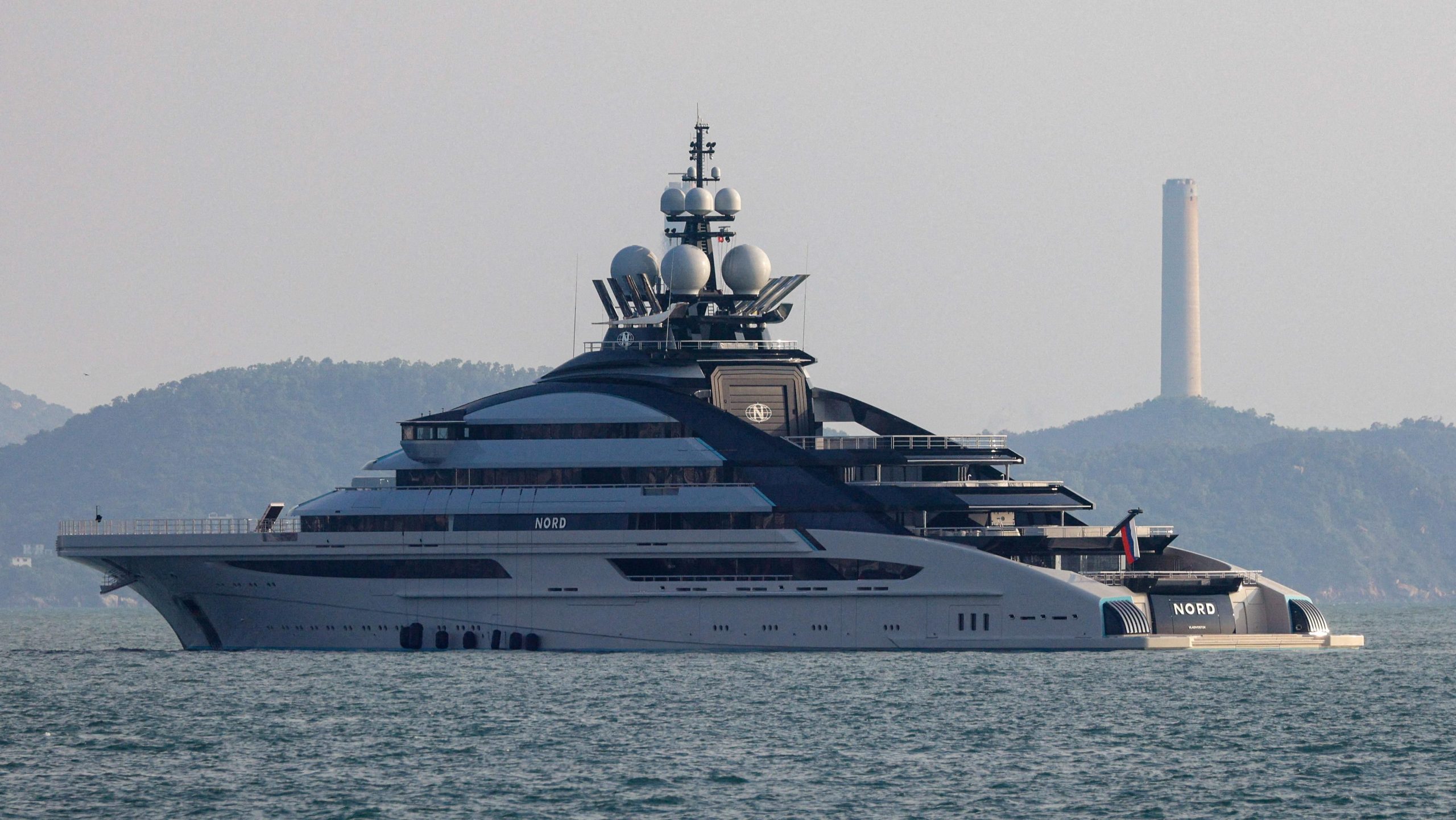
A superyacht linked to one of Russian President Vladimir Putin’s closest allies has passed through the Strait of Hormuz, despite the continuing blockade of one of the world’s most important shipping routes.
The vessel, named Nord, is a 142-metre luxury yacht linked to sanctioned Russian billionaire Alexei Mordashov. Over the weekend, it travelled from Dubai to Muscat in Oman, becoming one of the few private vessels known to have crossed the strait in recent months.
Its voyage comes at a time when Iran and the United States remain locked in a tense standoff over access to the waterway. The Strait of Hormuz normally carries around one-fifth of the world’s crude oil and liquefied natural gas supplies, making any movement through it closely watched by governments, traders and shipping companies.
Tracking data showed Nord leaving Dubai on Friday night and arriving at Al Mouj marina in Muscat on Sunday morning. The route visible on the tracking platform appears to match a corridor that has been used by vessels travelling with Iranian agreement, though it remains unclear whether the yacht received direct permission from Tehran.
Yacht Tied to Sanctioned Russian Billionaire
Mordashov is not formally listed as the owner of the Russian-flagged yacht, but records show Nord was registered in 2022 to a company owned by his wife. That link has kept the yacht in focus because Mordashov has been under sanctions from the United Kingdom, the United States and the European Union since Russia launched its full-scale invasion of Ukraine in 2022.
The billionaire built much of his fortune through Severstal, Russia’s largest steel and mining company, and is regarded as one of the country’s richest businessmen. Estimates have placed his wealth at about $37bn.
Nord itself is valued at more than $500m and is known for its lavish features, including a swimming pool, a submarine and a helipad. Its successful transit through such a tightly restricted area is likely to draw attention not only because of the yacht’s luxury, but also because of the political profile of the man linked to it.
Hormuz Restrictions Remain in Place
Iran has sharply limited movement through the Strait of Hormuz since the start of the latest conflict triggered by US and Israeli strikes on February 28. Tehran has warned that vessels approaching the strait could be targeted, while the United States has said its own forces would stop or turn back ships travelling to or from Iranian ports.
In Nord’s case, available route data does not suggest the yacht made any stop in Iran. The last reported location also appears to fall outside the eastern point where US Central Command says its blockade begins.
That may explain how the vessel was able to pass without interception. Even so, the crossing is notable because maritime traffic through the area remains far below normal levels. Most shipping has been disrupted, and any vessel making the passage now is doing so in a highly uncertain and politically sensitive environment.
Oil Markets and Global Trade Stay on Edge
The continuing disruption in the Strait of Hormuz has already had major consequences for global markets. Brent crude rose to $109 a barrel on Monday, reflecting renewed concern over energy supplies and the fragility of maritime access in the Gulf.
Because such a large share of global oil and gas passes through the strait under normal conditions, even limited exceptions to the blockade attract attention. Nord’s journey may not change the wider crisis, but it does highlight how selective, uneven or negotiable enforcement may appear in practice.
That is likely to fuel further questions about who can still move through the strait, under what conditions, and whether political influence now matters as much as formal rules or military control.
Russia and Iran Strengthen Ties as Diplomacy Stalls
The yacht’s passage also comes during a week of visible diplomatic warmth between Tehran and Moscow. As long-term peace efforts with Washington remain stuck, Iran has shifted much of its diplomatic energy towards strengthening ties with Russia.
On Monday, President Vladimir Putin hosted an Iranian delegation in St Petersburg, where Iranian Foreign Minister Abbas Araghchi praised the strategic relationship between the two countries. According to Russian media, Putin said the Iranian people were fighting courageously for their sovereignty under US and Israeli pressure.
Araghchi later shared photos of his meetings with Putin and Russian Foreign Minister Sergei Lavrov, saying recent developments had shown the strength and depth of the partnership between Iran and Russia. He also welcomed Moscow’s support for diplomacy.
Against that backdrop, the passage of a Russian-linked superyacht through Hormuz carries wider symbolic weight. It is not just a story about a luxury vessel making an unusual trip. It is also a sign of how global alliances, sanctions, conflict and maritime power are increasingly intersecting in one of the world’s most sensitive waterways.