
North Korean leader Kim Jong Un has publicly praised soldiers who killed themselves rather than be captured while fighting alongside Russian forces in the war against Ukraine, appearing to confirm a policy that had long been suspected by intelligence agencies and defectors.
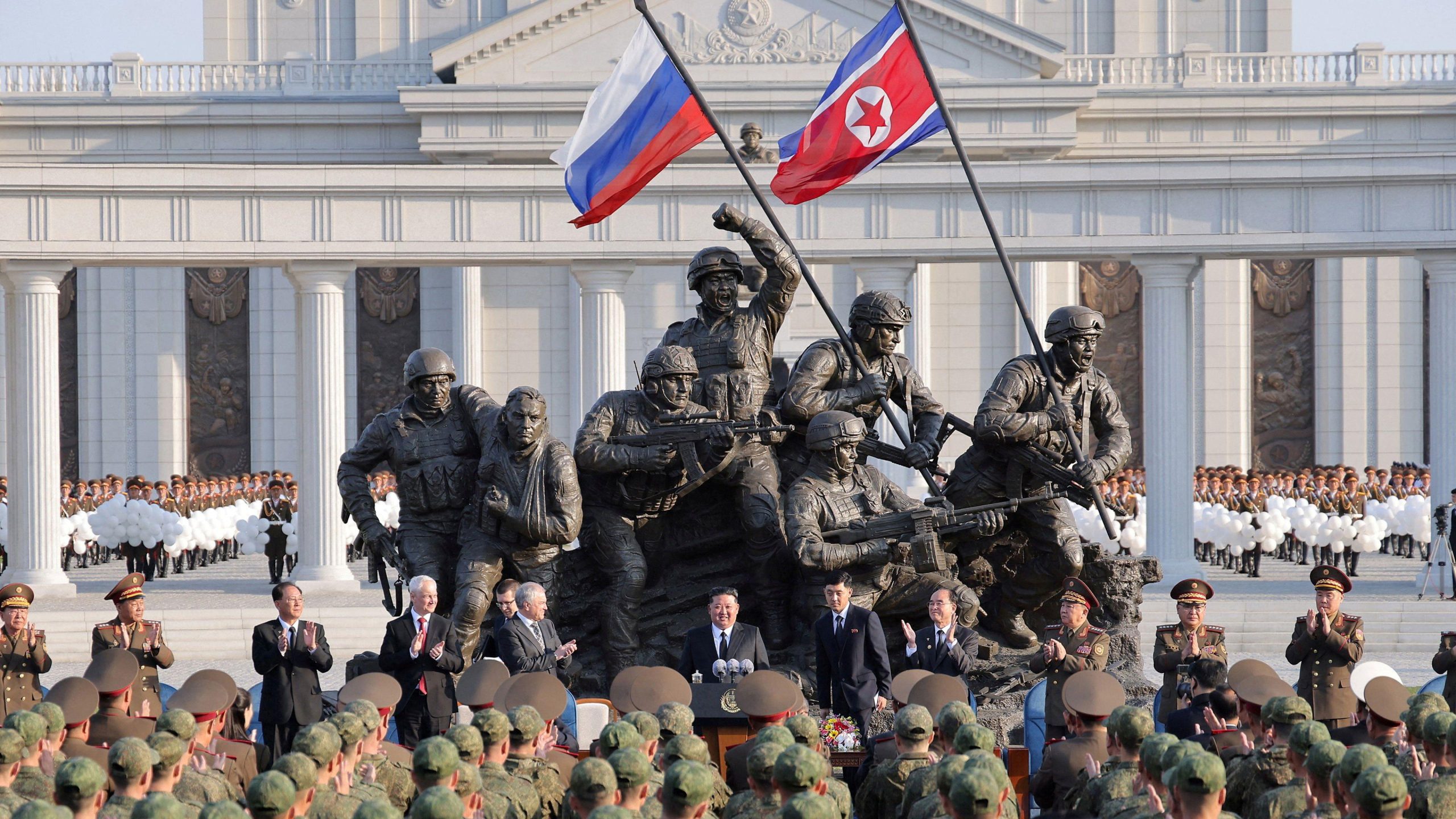
In a speech delivered this week, Kim described those troops as heroes, saying they had acted without hesitation to defend what he called the honour of the state. His remarks were made during the unveiling of a memorial dedicated to North Korean soldiers killed in battle, according to state media.
The speech is significant because it openly endorses a practice that had previously been reported by outside observers but never clearly acknowledged by Pyongyang. Intelligence agencies in South Korea and testimony from defectors have for some time suggested that North Korean troops were instructed to avoid capture at all costs, even if that meant taking their own lives on the battlefield.
Kim’s latest comments now give those claims stronger weight, turning what had once been a suspected wartime order into a message publicly celebrated at the highest level of the North Korean leadership.
North Korean Troops Reportedly Deployed to Support Russia
South Korean officials estimate that at least 15,000 North Korean troops have been sent to assist Russian forces, particularly in efforts to regain territory in the western Kursk region. According to those estimates, more than 6,000 of them have already been killed.
Neither Moscow nor Pyongyang has officially confirmed those numbers. Still, the scale of the reported deployment and losses has drawn growing international attention, especially as North Korea’s role in the conflict appears to be expanding.
Kim’s speech did not focus on the exact number of troops involved, but it made clear that the North Korean leadership sees the dead as symbols of loyalty and patriotism. He praised not only those who chose death over capture, but also soldiers who died in combat while trying to carry out their orders.
In doing so, he framed battlefield sacrifice as a central part of military duty, reinforcing the culture of total obedience that has long been associated with North Korea’s armed forces.
Capture Treated as Betrayal in North Korean Military Culture
In North Korea, being taken prisoner is widely regarded as a form of treason. That military mindset helps explain why the issue of capture carries such strong ideological weight in the country.
Earlier this year, South Korean broadcaster MBC aired footage featuring two North Korean prisoners of war held in Ukraine. One of them said on camera that he regretted not ending his life, saying others had done so while he had failed. That testimony added to earlier claims that North Korean soldiers had been trained or pressured to avoid capture under any circumstances.
Seoul’s National Intelligence Service also said last year that documents recovered from dead North Korean soldiers pointed to the same practice. Those findings were seen as further evidence that battlefield self-destruction was not simply an individual choice, but part of a wider expectation placed on troops.
Kim’s speech now appears to align with that evidence, presenting such acts not as tragedy, but as examples of the highest form of loyalty.
Russian Officials Attend Memorial Event in Pyongyang
The memorial event where Kim gave his remarks was also attended by senior Russian figures, including Defence Minister Andrey Belousov and Vyacheslav Volodin, the speaker of Russia’s parliament.
Their presence highlighted the increasingly close relationship between Moscow and Pyongyang. Since the start of Russia’s full-scale war in Ukraine, that partnership has drawn growing concern from Western governments and regional observers.
In June 2024, Russian President Vladimir Putin and Kim Jong Un signed an agreement pledging mutual support if either country faced aggression. At the time, Kim described the deal as the strongest treaty ever reached between the two states.
That agreement appears to have laid the foundation for North Korea’s deeper involvement in Russia’s war effort. In addition to sending troops, Pyongyang has also promised to dispatch thousands of workers to help rebuild parts of Kursk.
A Deeper Military Alliance Comes Into View
Kim’s praise for soldiers who died rather than be captured offers more than just a glimpse into North Korea’s military culture. It also signals how far the country is willing to go in supporting Russia’s campaign in Ukraine.
The speech presents sacrifice, obedience and death in battle as acts worthy of national honour. At the same time, it reinforces concerns that North Korea’s participation in the war is not limited to symbolic backing, but includes direct and highly disciplined involvement on the battlefield.
As cooperation between Moscow and Pyongyang grows, the memorial event and Kim’s remarks are likely to be seen as another sign that the two governments are strengthening not only diplomatic ties, but also military and ideological alignment.
For outside observers, the message from Pyongyang was stark: the North Korean leadership is not only aware of these battlefield deaths, but is also openly glorifying them as proof of loyalty and commitment.