
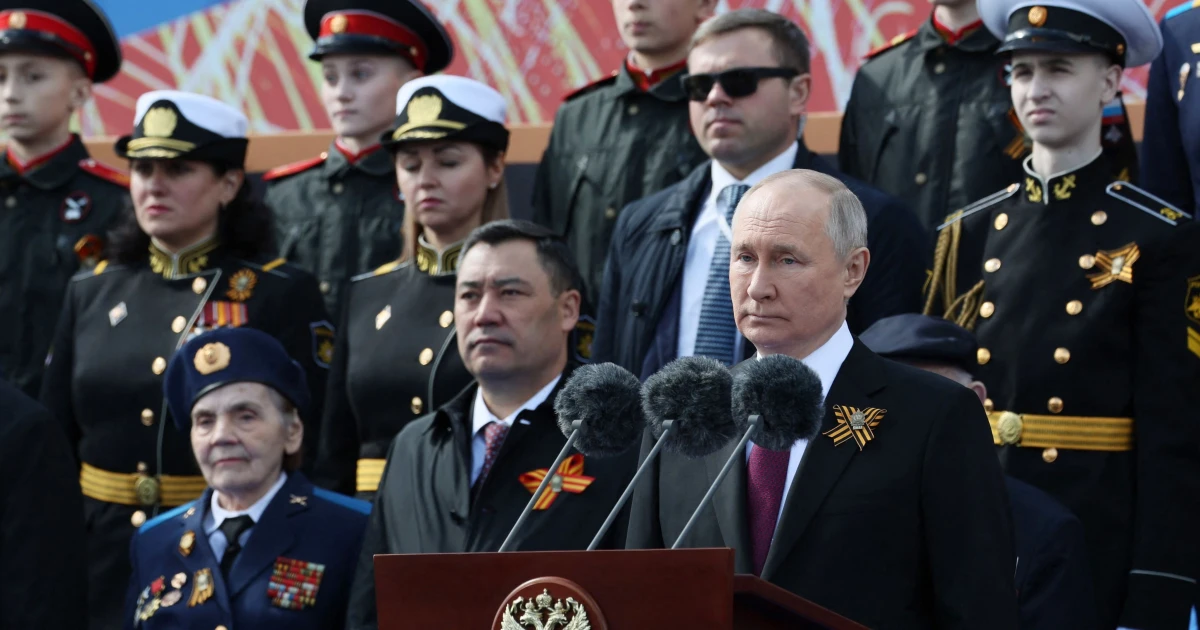
Vladimir Putin used his annual Victory Day speech in Moscow’s Red Square to defend Russia’s war in Ukraine and attack NATO, as this year’s celebrations unfolded on a smaller scale under heavy security.
Speaking before rows of military personnel, the Russian president described the war as just and accused Ukraine of acting as an aggressive force backed by the entire NATO alliance. His remarks placed the current conflict directly alongside the Soviet Union’s fight against Nazi Germany, using one of Russia’s most symbolic national ceremonies to reinforce support for the war.
Victory Day remains Russia’s most important secular holiday, commemorating the Soviet victory in the Second World War. But this year’s events were noticeably more restrained, reflecting both wartime pressure and growing fears of possible attacks.
Parade held under tighter security and without heavy weapons
The Red Square parade began in the morning with marching troops and ceremonial formations, but for the first time in years it took place without tanks, ballistic missiles or other major armoured equipment.
Instead, the event relied on marching units and a more limited military display. The decision to scale back the parade was officially linked to the current operational situation, with Russian authorities pointing to the threat of Ukrainian drone strikes and other security concerns.
Even without the usual heavy hardware, military personnel still crossed Red Square in large numbers, and the event remained closely choreographed. Cannons fired after Putin’s speech, followed by music from a military brass band, preserving the ceremony’s symbolic power even in a reduced format.
Putin frames the Ukraine war as part of a larger patriotic struggle
In his address, Putin first honoured the sacrifices made by Soviet soldiers during World War II, then quickly connected that memory to Russian troops fighting in Ukraine today.
He said the achievement of the generation that defeated Nazi Germany now inspires soldiers carrying out what the Kremlin still calls a special military operation. He claimed those troops are confronting an aggressive enemy armed and supported by NATO, and insisted that Russia’s cause remains just.
Putin also broadened his message beyond the military, praising workers, scientists, inventors, teachers, doctors and journalists for helping sustain the country during wartime. He argued that the future of the nation depends not only on battlefield tactics but on the people’s endurance and loyalty.
The speech once again showed how Victory Day has been turned into a political stage for the Kremlin, blending historical memory with present-day military messaging.
Ceasefire announcement overshadowed by fresh accusations
The parade took place just after Donald Trump announced that Russia and Ukraine had agreed to observe a three-day ceasefire running from Saturday to Monday, with a prisoner exchange also expected.
Despite that, tensions remained visible. After the ceremony, Russia’s defence ministry accused Ukraine of breaking the ceasefire, although it did not immediately provide details. Ukraine did not respond right away.
Earlier in the week, Putin had announced a ceasefire for May 8 and 9, while Kyiv had called for an indefinite truce starting on May 6. Since then, both sides have repeatedly accused each other of violating those pauses.
That left the Red Square event taking place not in a stable calm, but in the middle of a fragile and disputed break in fighting.
Foreign attendance was lower than in previous years
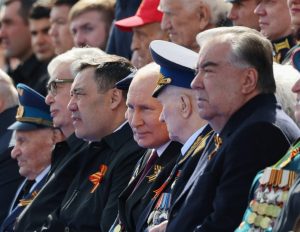
A smaller group of foreign dignitaries attended the parade compared with past years. Among those present were Belarusian leader Alexander Lukashenko, Malaysia’s King Sultan Ibrahim, Uzbekistan’s President Shavkat Mirziyoyev and Slovak Prime Minister Robert Fico, who was the only European Union leader to attend.
The contrast with last year was striking. The previous major anniversary celebrations drew many more foreign leaders, including Chinese President Xi Jinping and Brazil’s President Luiz Inácio Lula da Silva.
This year’s lower turnout reflected Russia’s deeper isolation, even as the Kremlin tried to use the event to project strength and legitimacy.
A symbolic celebration shaped by war
Victory Day has long carried deep emotional importance in Russia, where the Soviet Union’s wartime losses remain central to national identity. Under Putin, however, the occasion has also become an increasingly political display of state power and military pride.
This year’s version showed both continuity and strain. The message of sacrifice, patriotism and unity remained strong, but the absence of heavy weapons, the reduced scale and the tightened security all pointed to a country marking its most symbolic holiday while deeply shaped by an ongoing war.
In that sense, the parade was not only about remembering the past. It was also about defending the present, with Putin using the occasion to justify Russia’s campaign in Ukraine and sharpen his attack on NATO.