

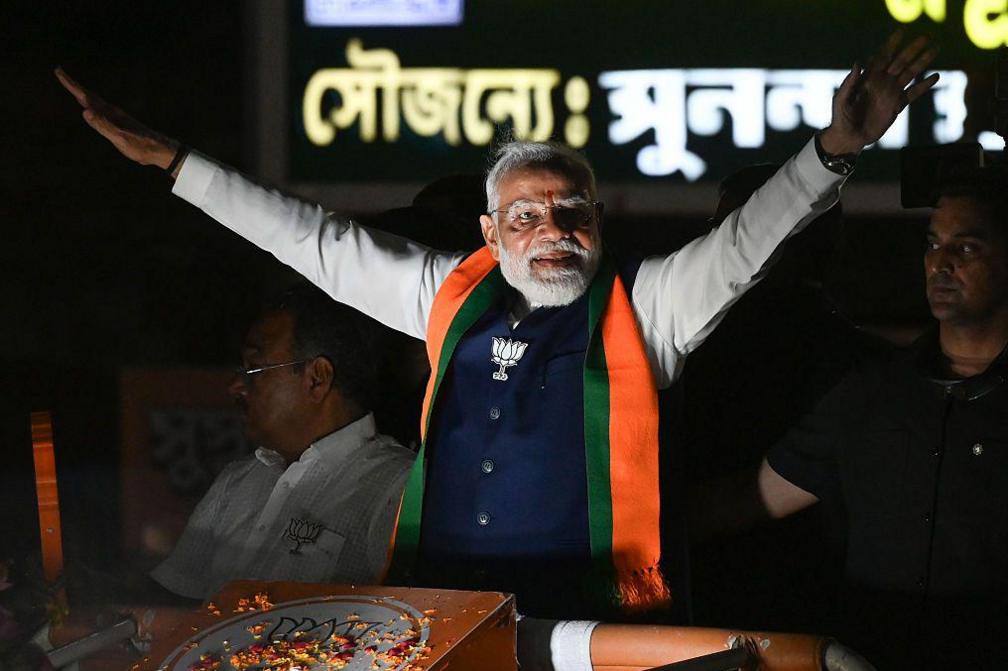
For years, West Bengal stood out as one of the few major regions where Narendra Modi Bharatiya Janata Party could not complete its national rise. The party had expanded across much of India, but Bengal remained politically resistant, shaped by a strong sense of cultural identity and a long history of dominance by powerful regional forces.
That changed with this election. The BJP’s victory in West Bengal marks one of the most important breakthroughs of Modi’s rule, not just because it defeated a three-term incumbent, but because it represents the party’s long-awaited entry into one of India’s most difficult political frontiers. In a state with more than 100 million people, the result carries weight far beyond a routine provincial contest and is being seen as a major national moment.
A state known for hegemonic politics finally changes hands again
West Bengal has rarely changed governments in the last half century. The Communist Left Front ruled the state for 34 years before Mamata Banerjee’s Trinamool Congress took power and then held on for 15 years. Political observers have often described Bengal as a system that tends to favour dominant parties once they are firmly established.
That is what makes the BJP win especially striking. This was not a sudden upset created by a last-minute swing. Analysts quoted in the report say the result is better understood as the end point of a slow and deliberate political project that has unfolded over several election cycles.
Rahul Verma of the Centre for Policy Research said the BJP had already established itself in Bengal over three consecutive elections, regularly polling around 39 percent of the vote. Once it reached that level, he argued, the party only needed a relatively small additional shift to move from strong challenger to winner. This time, voting trends showed the BJP crossing 44 percent, giving it the extra push it needed.
The BJP won despite a thinner local network
One of the more revealing parts of the result is that the BJP appears to have won even without the kind of deeply rooted local organisation that regional parties have traditionally relied on to dominate Bengal.
The Trinamool Congress still had a denser grassroots structure and the continuing personal appeal of Mamata Banerjee. Yet the BJP managed to hold and expand a powerful vote share despite those disadvantages, and despite allegations of political intimidation from rivals. According to Verma, that suggests the BJP’s support has now grown beyond the limits of its relatively thin local machinery.
In other words, the party is no longer just an outsider benefiting from protest votes. It has become a genuine force across large parts of Bengal’s electorate.

Welfare fatigue and polarisation shifted the contest
For years, Banerjee’s success rested on a broad social coalition that included women, Muslims and many Hindu voters in both urban and rural areas. Women, in particular, were central to the Trinamool Congress model, with female-focused welfare programmes helping the party build a durable support base.
This time, however, that formula appears to have weakened. The BJP directly challenged the TMC’s welfare advantage by promising larger cash transfers and expanded benefits of its own. Political scientist Bhanu Joshi said Banerjee’s long success depended on a delicate balance between welfare and organisation, but over time that same party machinery became a liability.
As the organisation weakened and welfare began to feel routine rather than transformative, Joshi argued, the BJP found its opening by turning anti-TMC fatigue into a sharper politics of Hindu consolidation. In that reading, the election was not simply about welfare losing its appeal. It was about welfare and party organisation no longer being strong enough to contain growing political and religious polarisation.
Muslim voters remained central, but the BJP widened Hindu consolidation
Religion remained central to the political math. Muslims make up roughly 27 percent of Bengal’s population, and nearly a third of the state’s seats have significant Muslim populations. In the last election, the TMC had swept most Muslim-dominated seats, showing strong support from that bloc.
Early indications suggest Banerjee may still have retained substantial Muslim backing. But the BJP appears to have offset that by consolidating larger sections of Bengali Hindu voters while also pushing its own welfare promises. Political scientist Maidul Islam said the BJP combined an aggressive welfare pitch with more visible communal polarisation, helping rally portions of the Hindu electorate behind it.
BJP leaders, meanwhile, framed the result less as ideological consolidation and more as a rejection of the TMC itself. Senior BJP figure Dharmendra Pradhan said voters, especially women angry over law-and-order failures and alleged abuses, had decisively turned against Banerjee’s party.
Electoral roll revision remains controversial
Another major issue hanging over the election was the controversial revision of Bengal’s electoral rolls. The Election Commission said the process was designed to clean up voter lists by removing duplicates and ineligible names. But Banerjee, activists and civil society groups argued that the state had gone into the election after what they described as a mass disenfranchisement exercise.
The report says nearly three million voters were still waiting for tribunal decisions before polling, and critics argued that poor and minority communities, especially Muslims and migrants in border districts, were hit hardest. Analysts said the dispute over deleted names is likely to receive closer scrutiny in seats where victory margins were narrower than the number of removed voters.
Even so, many believe that the voter list controversy alone cannot explain the scale of the BJP’s surge. The party also benefited from a highly focused campaign built around allegations of corruption and governance failures inside the Trinamool Congress, especially cases such as the teachers’ recruitment scandal.
A result that strengthens Modi far beyond Bengal
The political effect of this result is likely to stretch far beyond the state. Unlike Bihar, where the BJP governs through alliances, or Odisha, where its breakthrough came against a weakened regional opponent, Bengal represents a direct and standalone conquest of one of India’s hardest political arenas.
Author and journalist Nilanjan Mukhopadhyay said the win would strengthen Modi enormously and be seen not only as a victory for the prime minister, but also for Home Minister Amit Shah, who is viewed as having effectively driven the campaign.
Mukhopadhyay also suggested the Bengal breakthrough could influence the BJP’s internal future, reinforcing Shah’s position in any next-generation power struggle within the party. That means the result matters not only for government formation in Bengal, but also for the future hierarchy of the BJP itself.
A new phase in Bengal and in the Modi era
For decades, West Bengal prided itself on resisting the political currents sweeping much of the rest of India. This election suggests that resistance has now been broken.
The BJP’s victory is more than a state-level win. It marks the breach of one of India’s most enduring regional strongholds and could signal the start of a new phase in Modi’s broader political project.
In Bengal, it brings the end of one era. In national politics, it may be remembered as the moment when one of India’s last major holdouts finally fell.