

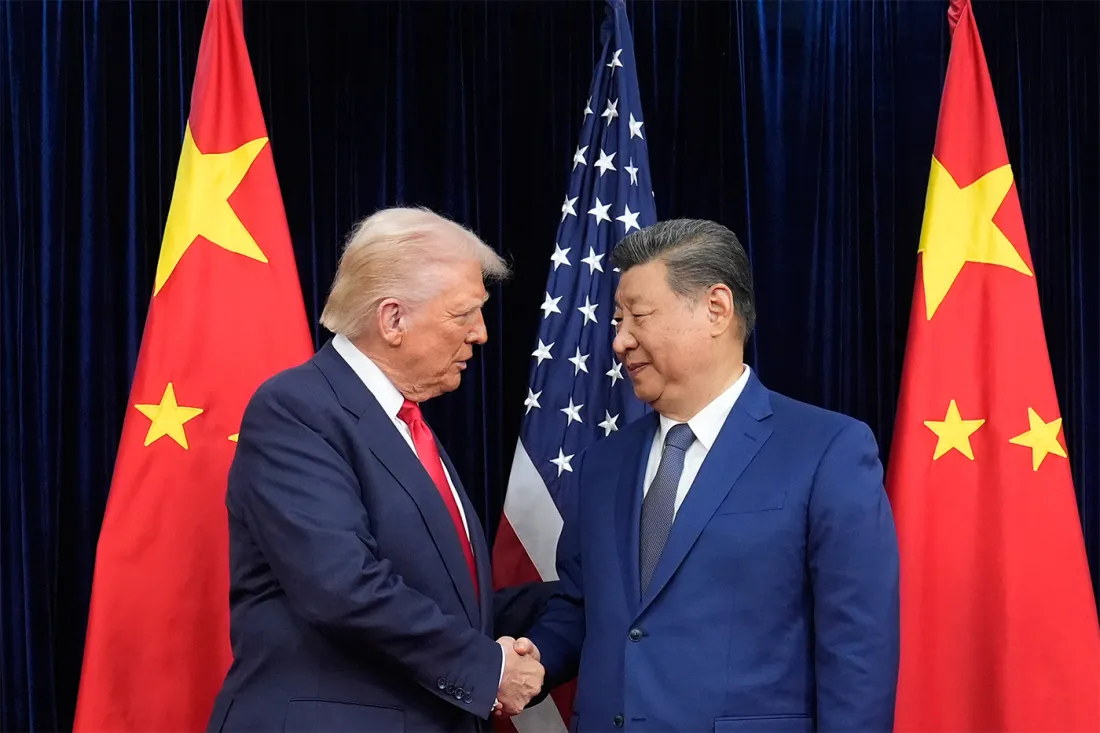
US President Donald Trump summit with Chinese President Xi Jinping in Beijing has produced warm diplomatic language and carefully arranged public moments, but few major economic results.
The visit brought together some of America’s most powerful business leaders, including Tesla chief Elon Musk, Nvidia CEO Jensen Huang and Boeing chief Kelly Ortberg. Their presence highlighted the importance of technology, trade and investment in the relationship between the world’s two largest economies.
However, despite the grand welcome and positive statements from both sides, the summit has not produced a sweeping trade agreement or major breakthrough. Instead, the talks appear to have focused on maintaining stability and extending the fragile trade pause agreed earlier in South Korea.
Trump and Xi Praise Talks but Differences Remain
Trump met Xi on Thursday for more than two hours at the Great Hall of the People. The US president described the relationship between Washington and Beijing as the world’s most important economic partnership.
The White House called the meeting highly productive, while Trump suggested it could become one of the most significant summits ever.
Xi also pointed to progress from previous negotiations, but he delivered a serious warning over Taiwan. According to Chinese state media, Xi said the issue remained the most sensitive part of US-China relations and warned that mishandling it could push the two countries toward conflict.
The message made clear that even as both sides discuss trade and investment, deep political tensions remain at the center of the relationship.
CEOs Take Center Stage in Beijing
One of the most striking moments of the visit came when Air Force One arrived in Beijing. Elon Musk was seen stepping off the aircraft ahead of senior US officials, including members of Trump’s cabinet and trade team.
Musk and Nvidia’s Jensen Huang were also positioned close to Trump during the welcome ceremony, underlining the role of technology in the summit.
Their presence was highly symbolic. Tesla relies heavily on its Shanghai factory and Chinese buyers, while Nvidia is deeply involved in the global race for artificial intelligence and advanced semiconductors.
Huang’s attendance was especially notable because he was not initially listed as part of the delegation. That sparked speculation that AI chips and technology access could become a bigger part of the talks than previously expected.
Trump later said China would invest hundreds of billions of dollars in companies connected to the executives in his delegation, but he did not provide clear details.
Boeing Deal Falls Short of Expectations
Trump also said China had agreed to order 200 Boeing aircraft, which would mark Beijing’s first major purchase of US-made commercial planes in nearly a decade.
Still, the announcement appeared to fall below what many analysts and investors had hoped for. Boeing shares dropped after Trump’s comments were aired, suggesting the market had expected a larger or more detailed agreement.
The aircraft order was one of the few specific business points mentioned publicly, but the lack of broader details kept expectations limited.
No Major Trade Deal Announced
Despite the strong visuals and high-level meetings, the summit did not deliver a major trade deal.
Instead, both sides pointed to the continuation of the existing trade truce reached in October. Under that arrangement, Washington paused sharp tariff increases on Chinese goods, while Beijing eased back from restrictions on rare earth exports.
The White House said Trump and Xi agreed to create a “Board of Trade” to manage the economic relationship without reopening tariff negotiations every time tensions rise.
US Treasury Secretary Scott Bessent also said he expected progress on a system to support future investment between the two countries. However, US officials warned that significant work is still needed before these plans can operate fully.
Market Access and Investment Still Unclear
According to the White House, Trump and Xi discussed expanding Chinese market access for US companies and increasing Chinese investment in American industries.
Beijing signaled that it would buy more US agricultural and energy products. American farmers have long pushed for stronger Chinese demand for soybeans, beef and poultry, but no firm details were announced during the first stage of the summit.
Bessent played down expectations of a major agricultural breakthrough, saying some soybean commitments had already been handled under earlier agreements. However, he suggested there could be more room for Chinese purchases of US energy, including liquefied natural gas.
US Trade Representative Jamieson Greer later said he expected an agricultural deal sometime this year.
Xi told American business leaders that China’s doors would open wider and that US firms would have broader opportunities in the Chinese market. He also called for more cooperation in trade, agriculture, healthcare, tourism and law enforcement.
Taiwan Becomes a Bigger Trade Risk
One of the clearest messages from Beijing was that Taiwan is no longer being treated as a separate political issue. Instead, China is linking Taiwan more directly to the wider US-China relationship, including trade.
In past negotiations, Taiwan was one of several points of tension, alongside tariffs, semiconductors and arms sales. But during this summit, Chinese officials framed Taiwan as a core condition for stable relations.
Xi reportedly told Trump that Taiwan is the most important issue in China-US ties. His warning showed that any progress on trade could still be affected by Washington’s relationship with Taipei.
Technology Remains the Main Divide
Technology continues to be one of the biggest obstacles between the two countries.
US export controls on advanced semiconductors and chipmaking equipment remain in place. These restrictions are designed to limit China’s access to cutting-edge AI technology.
China has continued to criticize the controls, saying they restrict its industrial growth. At the same time, Beijing continues to push for greater access to advanced technology.
Although AI was expected to be a major topic, it was not heavily mentioned in the early official summaries of the summit. Bessent said discussions on AI guardrails were taking place and stressed that the US must maintain its lead in artificial intelligence while avoiding rules that could slow innovation.
Iran and Energy Stability Also Discussed
Trump also entered the summit hoping for Chinese cooperation on the Iran conflict and global oil stability.
Disruptions in energy routes and rising oil prices have affected both China and the broader global economy. Trump has said China could use its influence to encourage Iran to help stabilize shipping through the Strait of Hormuz, a key route for global energy supplies.
Chinese summaries indicated that the Middle East was discussed, but few details were released.
More Talks Expected Before Washington Meeting
At a state banquet in Beijing, Trump invited Xi to visit the White House on September 24. Further discussions are expected before that meeting.
For now, the Beijing summit appears to have delivered more symbolism than substance. It helped maintain dialogue and preserve the fragile trade truce, but it did not produce the major economic breakthrough Trump had hoped for.
The presence of top CEOs showed the importance of business ties between the US and China. But with unresolved disputes over tariffs, Taiwan, AI, semiconductors and energy security, both sides remain far from a broad trade deal.