

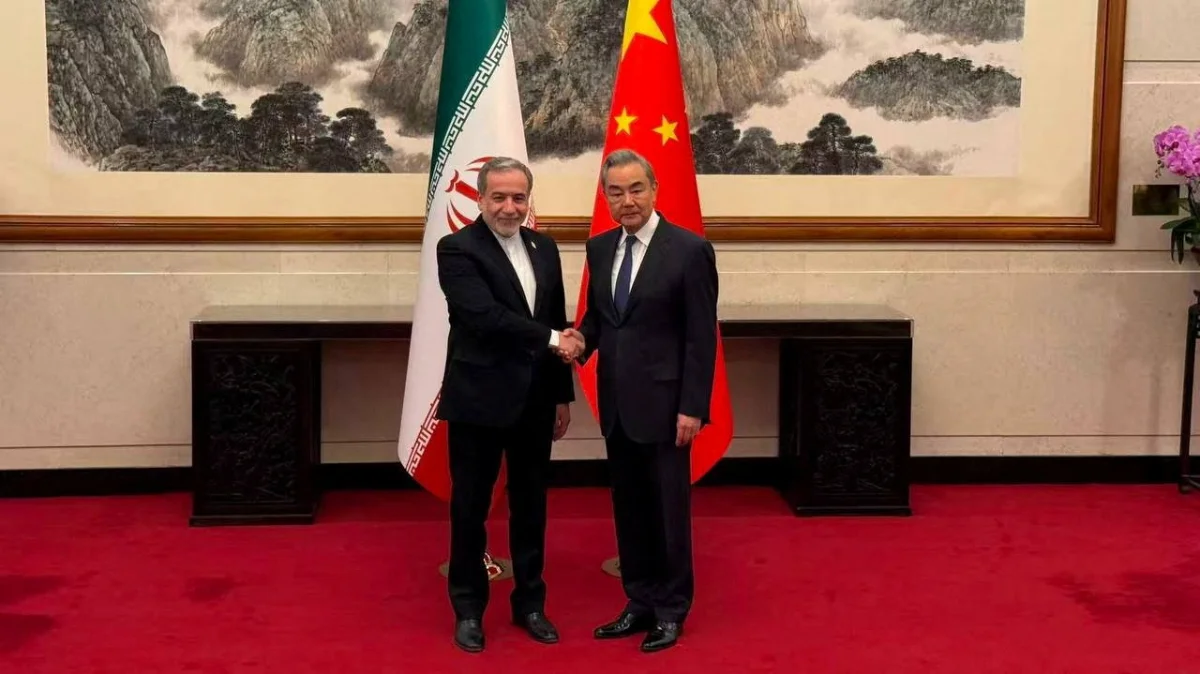
China has called for the Strait of Hormuz to reopen as soon as possible, with Foreign Minister Wang Yi urging progress during talks in Beijing with his Iranian counterpart Abbas Araqchi.
The meeting marked Araqchi’s first visit to China since the Iran war began and came at a critical moment for regional diplomacy. Wang said securing a lasting ceasefire should be treated as an urgent priority and warned that any return to open fighting would only worsen the situation. He also stressed that negotiations must continue and said Beijing was ready to play a role in reducing tensions.
China’s message was clear: restoring safe passage through the Strait of Hormuz is now a matter of international concern, and the pressure to stabilise the region is growing.
Strait of Hormuz remains a central concern
The Strait of Hormuz has become one of the most sensitive flashpoints of the conflict. Since the war, the route has been largely blocked because of restrictions and blockades imposed by both Iran and the United States.
That disruption has had global consequences, given the waterway’s importance to oil transport. A large share of the world’s crude passes through the strait, making its closure a serious threat to energy markets and international trade.
Wang said the international community shares deep concern over the need to restore normal and secure navigation in the area. His comments showed that Beijing wants movement on the issue quickly, especially as uncertainty around the strait continues to affect both regional stability and global supply chains.
China keeps calling for dialogue
Beijing has tried to position itself as a voice for restraint throughout the crisis. While avoiding direct involvement in the conflict, China has repeatedly encouraged Washington and Tehran to keep talking rather than return to military escalation.
Wang repeated that point in his meeting with Araqchi, underscoring the importance of diplomacy over confrontation. He also said China appreciated Iran’s stated commitment not to develop nuclear weapons, a line that fits Beijing’s broader effort to support negotiation while avoiding a deeper regional rupture.
For Iran, the visit also carried symbolic importance. Araqchi said ties between Tehran and Beijing would grow even stronger, suggesting both countries want to show continuity in their partnership even during a highly unstable period.
Summit with Trump adds more weight to the talks
The timing of the Beijing meeting is especially notable because it comes just a week before Donald Trump is expected to meet Chinese President Xi Jinping. The Iran war and the future of the Strait of Hormuz are likely to be among the major issues discussed.
Both Trump and Iranian officials have previously credited China with helping support acceptance of the Pakistan-brokered ceasefire reached in April. That gives Beijing a potentially important role ahead of the summit, especially as the US and Iran remain far from a full settlement.
China has also criticised the US naval blockade of Iranian ports, calling it irresponsible and dangerous and warning that it risks weakening an already fragile ceasefire.
China’s oil dependence raises the stakes
China’s concern over the strait is not only diplomatic. It is also economic. China has been a major buyer of Iranian oil despite US sanctions, and a significant share of its crude imports depends on the stability of routes connected to Hormuz.
That makes Beijing particularly sensitive to prolonged disruption in the Gulf. Even so, Trump recently said Xi had been respectful over the issue and claimed China had not challenged the United States during the crisis.
With the Trump-Xi meeting approaching, Beijing’s latest message appears aimed at reinforcing a simple position: the ceasefire must hold, talks must continue, and the Strait of Hormuz needs to reopen before the situation becomes even more dangerous for the region and the wider world.