

President Donald Trump Project Freedom was presented as a US effort to help vessels trapped by Iran’s closure of the Strait of Hormuz, but the operation was paused just two days after it was announced, raising new questions about whether it could actually ease the crisis or instead trigger more fighting.
Trump first described the initiative as a humanitarian step intended to help people, companies and countries that had done nothing wrong. But after its launch, the operation quickly ran into military tension, diplomatic uncertainty and practical concerns from the shipping industry. By Tuesday, Trump said the project would be suspended for a short time to see whether the United States and Iran could still reach an agreement.
Why the operation was launched
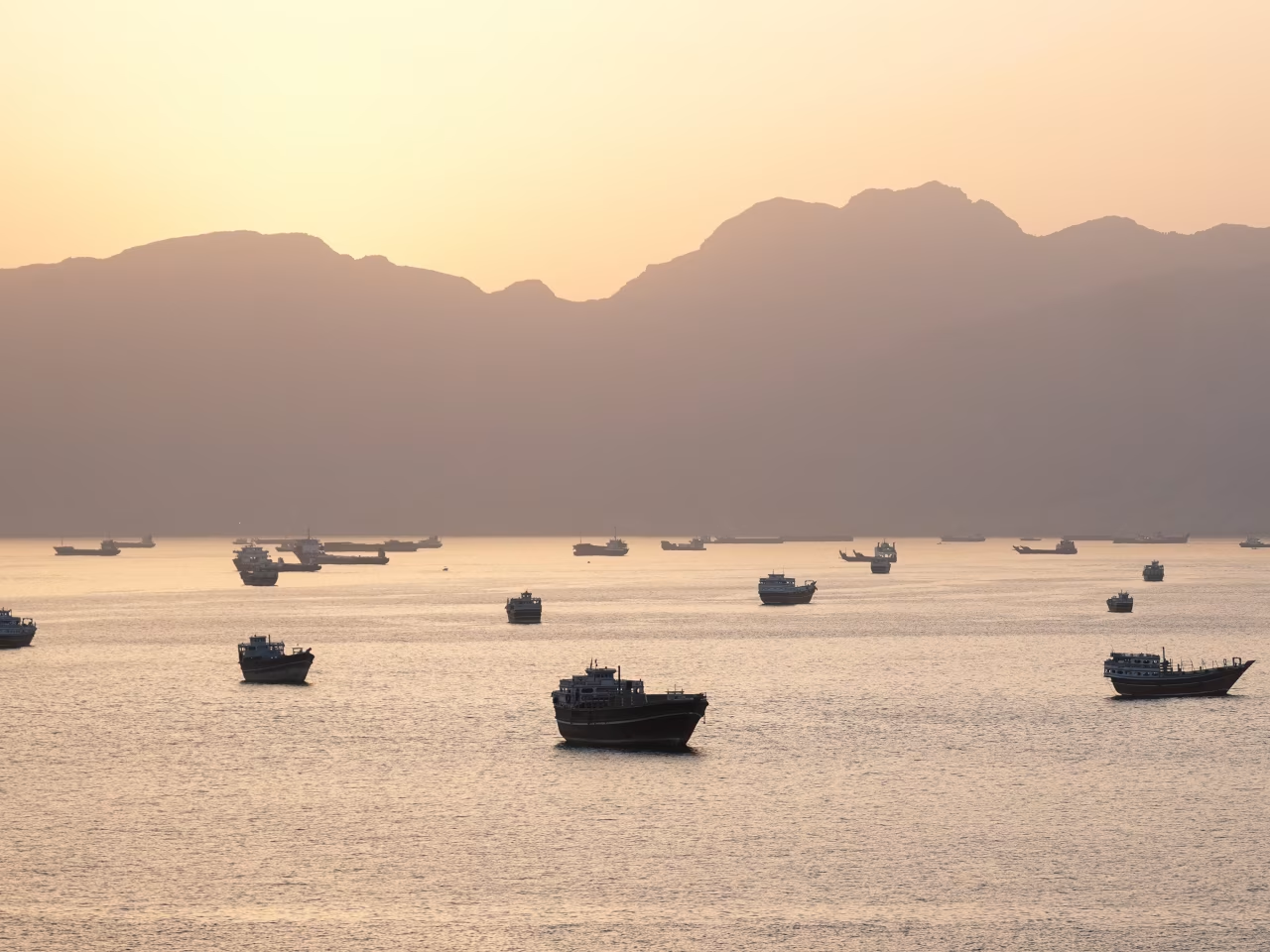
The Strait of Hormuz has remained largely blocked since the United States and Israel launched air strikes on Iran on 28 February, after which Tehran responded by restricting the vital waterway. Around 20 percent of the world’s oil and liquefied natural gas normally passes through the strait, making the disruption a major global concern.
According to the report, the US says there are 22,500 mariners aboard 1,550 commercial vessels currently stranded in the Gulf. That has increased concern not only about global energy flows, but also about the physical and mental health of crews stuck for long periods in a dangerous zone.
Project Freedom was supposed to show that Washington was willing to step in and support movement through the waterway. But even from the start, it was not fully clear how the mission would work in practice.
How the US said it would carry out the mission
US Central Command said the operation would involve guided-missile destroyers, more than 100 land- and sea-based aircraft, multi-domain unmanned systems and 15,000 service members. At a briefing on the first day, Centcom commander Admiral Brad Cooper said ships from 87 countries were stranded in the Gulf and that the US had contacted dozens of vessels and shipping firms to encourage traffic to resume.
Even so, a key uncertainty remained: whether the US would provide direct naval escorts. According to analysts and maritime industry figures quoted in the report, Washington appeared more likely to offer air cover and defence against drone or missile attacks rather than physically escort every ship. Insurance concerns and a lack of coordination also made shipping companies wary. Tim Wilkins of Intertanko said the Trump administration had not put in place clear coordination for the operation, leaving tanker operators worried about safety in the strait.
Did any ships actually get through?
Centcom later said US Navy destroyers had operated in the Gulf after crossing the strait in support of Project Freedom. It also said two US-flagged merchant vessels had successfully passed through and were safely continuing their voyages, although it did not name them. Maersk confirmed that one of its vessels had left the Gulf with US military support.
Iran’s Revolutionary Guard, however, denied that any vessels had passed through the strait. With the operation now paused, it remains unclear whether more commercial ships will be able to move in the near future or whether these examples were only limited exceptions.
Why the plan quickly became risky
Hours after the mission was due to begin on Monday, Iran said it had fired against what it described as American and Zionist enemy destroyers. Centcom rejected Iranian claims that a US warship had been hit, but confirmed that Iran did launch cruise missiles at US warships and US-flagged commercial vessels. It also said drones and small boats were used against commercial shipping.
The UAE said a tanker linked to its state oil company Adnoc was targeted by two drones while moving through the strait, though no one was injured. A suspected strike also hit a South Korean cargo vessel anchored near the UAE. Admiral Cooper said US helicopters involved in the mission were used to destroy six small Iranian boats that were targeting civilian vessels, though Iran denied that claim.
These incidents showed how quickly a shipping support mission could slide into direct confrontation. That is one reason many analysts described Project Freedom as highly risky and potentially escalatory.
Why Trump paused it
Trump said the pause came after what he described as great progress toward a complete and final agreement with Iran, and that the suspension happened at the request of Pakistan, which has been acting as an intermediary alongside other countries. At the same time, he said the Strait of Hormuz would remain blockaded during the pause.
Iranian state media portrayed the pause as a retreat by Trump after repeated failures to reopen the waterway. Analysts quoted in the report said the original plan would likely have needed a much stronger and more forceful military approach if it were to work on any sustained basis. Some suggested that renewed hostilities may still be more likely than not.
Is the war restarting?
US officials insist the ceasefire is still in place. Defence Secretary Pete Hegseth said the project was separate from the ceasefire and did not mean the truce had ended. Chairman of the Joint Chiefs of Staff General Dan Caine said Iran’s actions since the April 8 ceasefire, including attacks on commercial vessels and US forces, had not yet crossed the threshold for a return to major combat operations.
Even so, the overall picture remains unstable. Project Freedom was supposed to help restore confidence and movement in the Strait of Hormuz. Instead, it exposed how difficult and dangerous that task would be without a broader political settlement. For now, the project stands as a short-lived US attempt to free stranded shipping that quickly ran into the same military and diplomatic obstacles blocking the strait in the first place.